
- Home
- Secondary
- Subject Information
Mathematics
Back
Introduction
Mathematics has many applications in many walks of life including Business, Science, Geography, Construction, Design, Economics, Computing and statistics. It has enabled us to organise, communicate and manipulate information in efficient ways, and gives us the chance to explain and predict things in real life. The mathematics department at Tabor, therefore, strives hard to help pupils learn how to solve problems which require the use of mathematical knowledge and techniques.
Aims
- To create a positive attitude towards mathematics.
- To develop sound numerical skills.
- To develop a willingness to use algebraic skills to solve problems.
- To develop an understanding of statistical enquiry.
- To use and apply mathematics to solve problems.
- To use workings to clearly communicate solutions to problems.
- To be able to use a calculator accurately to carry out calculations.
Why study maths?
Maths skills are important to success both in school and everyday life. Maths skills are required to:
– Manage money and time.
– Explain how to solve problems.
– Use technology.
– Solve problems and make informed decisions.
How will my child learn mathematics at Tabor?
Children learn easily when they can connect mathematical concepts and procedures to their own experience. An important part of learning maths is learning how to solve problems. We encourage pupils to use trial and error to develop their ability to reason and to learn how to go about problem solving. They learn that there may be more than one way to solve a problem and more than one answer. They also learn to express themselves clearly as they explain their solutions. This is a particularly important skill within the maths curriculum.
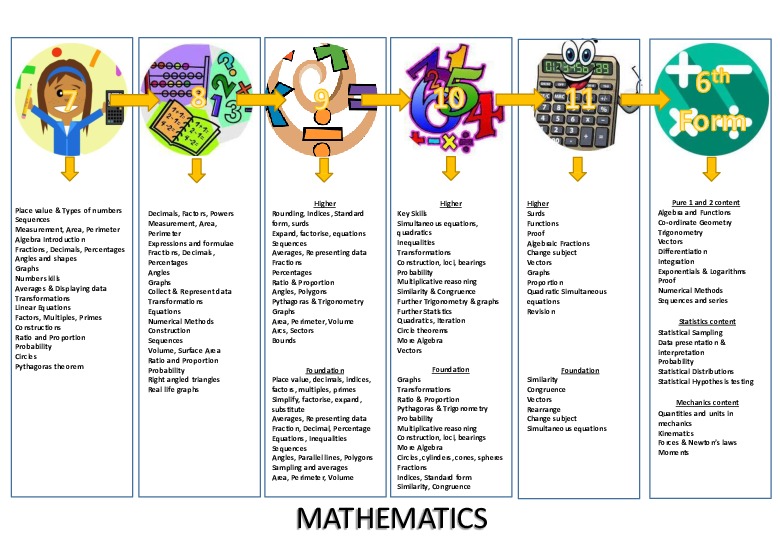
KS3
At Key Stage 3 pupils follow the key strands in mathematics.
- Number,
- Algebra,
- Geometry and Measures
- Probability
- Statistics
- Ratio, Proportion and rates of change
Within each strand a variety of topics are covered to prepare students for the GCSE course.
Course Description
|
Year 7 |
Year 8 |
Year 9 |
|
Written and calculator methods |
Whole numbers and decimals |
Higher |
|
Sequences |
Factors and powers |
Round, estimate, indices |
|
Units of measurements |
Measures, perimeter & area |
Standard form, surds |
|
Area and Perimeter |
Expressions and formulae |
Expand factorise, solve, rearrange |
|
Algebraic symbols |
Fractions, decimals & percentages |
Averages, represent data |
|
Fractions, decimals percentages |
Angles & 2D shapes |
Fractions, Decimals, Percentages |
|
Angles & shape properties |
Graphs |
Ratio & Proportion |
|
Graphs |
Collecting & representing data |
Angles in parallel lines, polygons |
|
Place value, decimals & negatives |
Transformations |
Pythagoras, Trigonometry |
|
Averages |
Equations |
Linear, quadratic & real life graphs |
|
Displaying data |
Written & calculator methods |
Area, perimeter, volume |
|
Transformations |
Constructions |
Arcs and sectors |
|
Linear equations |
Sequences and roots |
Error intervals & bounds |
|
Factors, multiples & primes |
3D shapes Volume & surface area |
|
|
Constructions, 3D shapes & volume |
Ratio and Proportion |
Foundation |
|
Ratio & Proportion |
Probability |
Place value, decimals, indices |
|
Probability |
Right angled triangles |
Powers, roots, factors, multiples |
|
Circles |
Standard form |
Simplify, expand, factorise, substitute |
|
Pythagoras |
Real life graphs |
Representing data |
|
Key skills |
Everyday maths |
Fractions, Decimals, Percentages |
|
|
|
Solve equations, rearrange |
|
|
|
Inequalities & sequence |
|
|
|
Angles, parallel lines, polygons |
|
|
|
Sampling & Averages |
|
|
|
Perimeter, Area, Volume |

KS4
In Key Stage 4, all students will be entered for GCSE Mathematics.
- Exam Board EDEXCEL
- Qualification GCSE Mathematics
- Code 1MA1
Tier: Higher (Grades 4-9 and U) or Foundation (Grades 5-1 and U)
The course is 100% exam assessed in the form of three equally weighted 1½ hour exams. Paper one is non-calculator and papers two and three are calculator. All questions are compulsory.
Students continue to be set in Key Stage 4 and students will be entered for the most suitable tier according to their ability.
The GCSE course continues to cover a wide range of mathematical concepts allowing students to further develop skills and knowledge in the key strands:
- Number
- Algebra
- Geometry and Measure
- Ratio, Proportion and rates of change
- Probability
- Statistics
Throughout the course students will be given opportunity to develop key skills in the application of number, problem solving and teamwork.
Course Description
|
Year 10 |
Year 11 |
|
Higher |
Higher |
|
Simultaneous equations, quadratics |
Vectors |
|
Inequalities |
Geometric proof |
|
Transformations |
Reciprocal/exponential graphs |
|
Construction, Loci, bearings |
Direct/Inverse proportion |
|
Probability |
Quadratic Simultaneous equations |
|
Multiplicative reasoning |
Gap topics |
|
Similarity & Congruence |
Revision |
|
Trigonometric graphs |
Past papers |
|
Further Trigonometry |
|
|
Data, cumulative frequency, histograms |
|
|
Quadratics |
|
|
Iteration |
|
|
Circle geometry & Circle theorems |
|
|
Rationalise surds |
|
|
Algebraic fractions |
|
|
Change subject |
|
|
Functions |
|
|
Algebraic proof |
|
|
Foundation |
Foundation |
|
Straight line & real graphs |
Similarity & Congruence |
|
Transformations |
Vectors |
|
Ratio and proportion |
Rearranging |
|
Pythagoras & Trigonometry |
Equations of lines – gradient/intercept |
|
Probability |
Simultaneous equations |
|
Multiplicative reasoning |
Gap topics |
|
Quadratics – expand, factorise |
Revision |
|
Quadratic graphs |
Past Papers |
|
Construction, Loci, bearings |
|
|
Circles, cones, cylinders, spheres |
|
|
Fractions & reciprocals |
|
|
Indices & Standard form |
|


Supporting students outside the classroom
Each pupil is given their own personal login and can use this website for ongoing revision of topics as well as watching the video’s for additional support in understanding concepts they are struggling with.
There are a variety of revision guides available to support students with the Mathematics course. The most popular with our students are:
- Collins All in one revision and practice Guide
- Pearson Edexcel Revision Guide and Revision Workbook
- CGP Complete Revision and practice Guide
Equipment
The basic equipment that students require on a daily basis:
- Pen
- Pencil
- Ruler
- Rubber
- Scientific Calculator
Extra equipment that will aid your child in their lessons and is required for exams:
- Protractor
- Compass
- Pencil sharpener
- Highlighter
Extra Curricular
Each year in March students in KS3 participate in World Maths Day.
They spend their maths lesson competing online in mathematical challenges with each other and students across the world. We also have puzzles and games available during lunchtime for students to take part in.


Careers In Maths
Useful Links
Tabor academy Curriculum statement Mathematics
Intent:
Vision
The Mathematics department at Tabor strives to enable students to build their confidence and love of Mathematics. The department empowers students to learn effective ways of building mental discipline and logical reasoning through deeper understanding, in order to apply the mathematical skills in their chosen careers and all aspects of the real world.
This is achieved through outstanding teaching, progress and attainment of all students and a well-designed curriculum that enables students to leave with the ability to apply maths through problem solving and thrive in the real world.
Our main aims:
- Students receive a high quality curriculum that stretches students’ learning.
- Students are able to solve mathematical problems through fluency, mathematical reasoning and problem solving.
Students understand the connection between the curriculum taught and both across other subjects and the real-life application.
Implementation
- Wide range of concrete, reasoning and problem-solving resources are used to develop students thinking skills and logical thinking.
- Lessons are engaging and follow a cycle of planning to ensure short-term and long-term progress.
- High level of questioning and modelling solutions are the centre of every lesson.
- Immediate interventions are used to support students’ gaps in their knowledge.
- Use of differentiation in lessons to stretch and support students’ learning.
- Home learning is set on weekly basis to review students’ learning.
- Numerical methods are taught in context to links with other subjects.
Impact
- All students are challenged.
- All students build a greater confidence and resilience in mathematical skills and have the ability to compete in the real world.
- Students become independent learners.
- Students make high levels of progress with above average levels of attainment.
- Students leave school with more choices and a greater earning potential for life due to maths skills.
Assessment and Expectation:
Key Stage 3:
Throughout Key Stage 3 students are broadly set according to ability. Groupings are reviewed throughout the year.
Assessment takes place each term and is in the form of a written paper which varies between non calculator and calculator.
Key Stage 4:
Throughout Key Stage 4 students are set according to ability with classes working towards either the Higher or Foundation GCSE Exam. Groupings are reviewed throughout the year. Final tier of entry is not confirmed until year 11.
Assessment takes place each term and is in the form of a written paper which varies between non calculator and calculator. Year 10 and year 11 exams consist of both non calculator and calculator papers.
All students are expected to have the basic equipment including a scientific calculator of their own.
Home Learning
Students will be set one piece of work each week for completing at home. Tasks will vary and could involve Mathswatch, Sparx maths or a written task.